 Add to Chrome
 Add to Firefox
 Add to Edge
Benchmarking Autonomous Agents against Temporal, Spatial, and Semantic Evasions
May 21, 2026
As autonomous agents (e.g., OpenClaw) increasingly operate with deep system-level privileges to execute complex tasks, they introduce severe, unmitigated security risks. Current vulnerability analyses overwhelmingly focus on single-turn, stateless behaviors, overlooking the expanded attack surface inherent in stateful, multi-turn interactions and dynamic tool invocations. In this paper, we propose a novel, multi-dimensional evasion framework targeting LLM-based agent systems. We introduce three stealthy attack vectors: (1) Temporal evasion, which fragments malicious payloads across sequential interaction turns; (2) Spatial evasion, which conceals payloads within complex external artifacts that evade standard LLM parsing mechanisms; and (3) Semantic evasion, which obscures malicious intents beneath benign contextual noise. To systematically quantify these threats, we construct A3S-Bench, a comprehensive benchmark comprising 2,254 real-world agent execution trajectories. Evaluating a standard agent framework separately integrated with 10 mainstream LLM backbones against 20 practical threat scenarios, we demonstrate that our evasion framework elevates the average risk trigger rate from a 28.3\% baseline to 52.6\%. These findings reveal systemic, architecture-level vulnerabilities in current autonomous agent systems that existing defenses fail to address, highlighting an urgent need for defense mechanisms tailored to the unique threats.

Provable Fairness Repair for Deep Neural Networks
May 19, 2026Deep neural networks (DNNs) are suffering from ethical issues such as individual discrimination. In response, extensive NN repair techniques have been developed to adjust models and mitigate such undesired behaviors. However, existing fairness repair methods are typically data-centric, which often lack provable guarantees and generalization to unseen samples. To overcome these limitations, we propose ProF, a novel fairness repair framework with provable guarantees. The key intuition of ProF is to leverage interval bound propagation (a widely used NN verification technique) to soundly capture model outputs over the whole set $S(\mathbf{x})$ around a biased sample $\mathbf{x}$. The derived bounds are utilized to guide fairness repair which encourages the model to produce consistent outputs on $S(\mathbf{x})$. Specifically, we integrate fairness constraints and model modifications into a unified constraint-solving formulation, which can be transformed to a Mixed-Integer Linear Programming (MILP) problem solvable by off-the-shelf solvers. The solution to the MILP problem effectively induces a repaired model with guaranteed fairness over the whole set $S(\mathbf{x})$. We evaluate ProF on four widely used benchmark datasets and demonstrate that it achieves provable fairness repair, with generalization of up to 95.93\% on full datasets and 93.16\% on the entire input space. Notably, ProF can be easily configured to support multiple sensitive attributes and more practical fairness definitions, while providing provable repair guarantees and delivering around 90\% fairness improvement. Our code is available at https://github.com/nninjn/ProF.
* 15 pages, 6 figures, 7 tables. full version of the paper accepted by ASE 2025
Taming OpenClaw: Security Analysis and Mitigation of Autonomous LLM Agent Threats
Mar 12, 2026Autonomous Large Language Model (LLM) agents, exemplified by OpenClaw, demonstrate remarkable capabilities in executing complex, long-horizon tasks. However, their tightly coupled instant-messaging interaction paradigm and high-privilege execution capabilities substantially expand the system attack surface. In this paper, we present a comprehensive security threat analysis of OpenClaw. To structure our analysis, we introduce a five-layer lifecycle-oriented security framework that captures key stages of agent operation, i.e., initialization, input, inference, decision, and execution, and systematically examine compound threats across the agent's operational lifecycle, including indirect prompt injection, skill supply chain contamination, memory poisoning, and intent drift. Through detailed case studies on OpenClaw, we demonstrate the prevalence and severity of these threats and analyze the limitations of existing defenses. Our findings reveal critical weaknesses in current point-based defense mechanisms when addressing cross-temporal and multi-stage systemic risks, highlighting the need for holistic security architectures for autonomous LLM agents. Within this framework, we further examine representative defense strategies at each lifecycle stage, including plugin vetting frameworks, context-aware instruction filtering, memory integrity validation protocols, intent verification mechanisms, and capability enforcement architectures.
ADVREPAIR:Provable Repair of Adversarial Attack
Apr 02, 2024
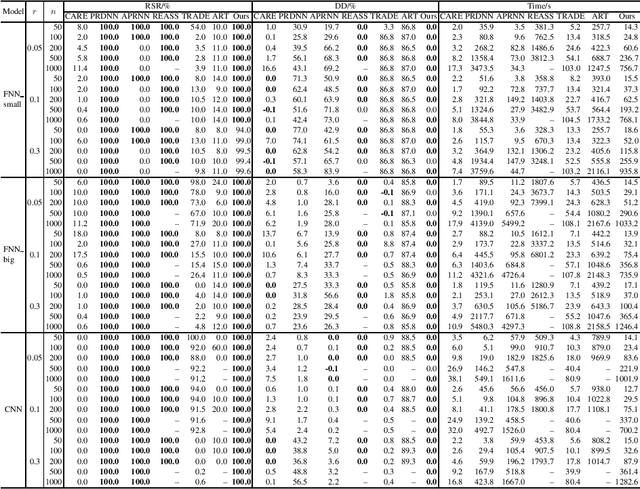
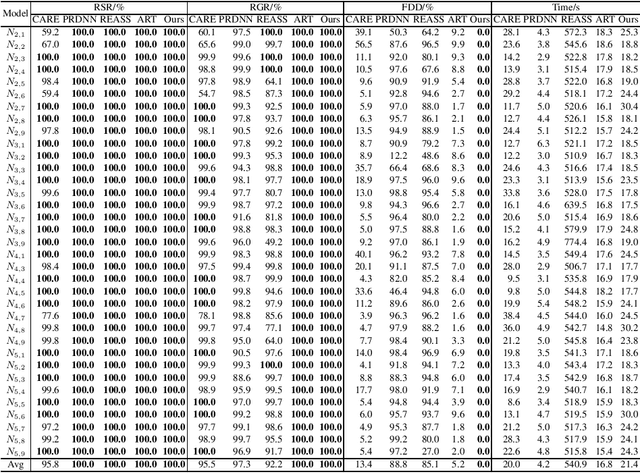
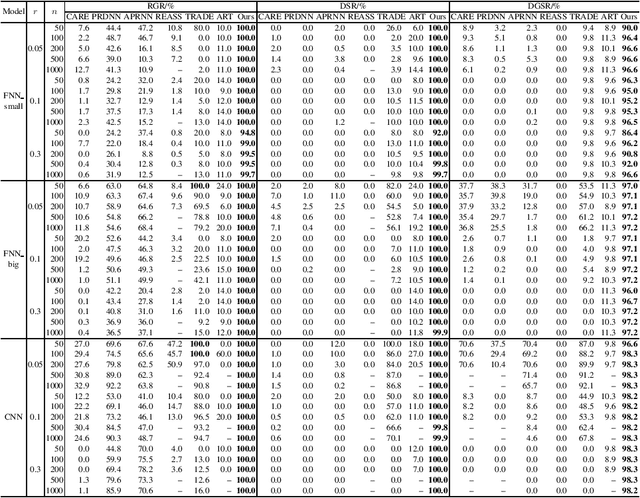
Deep neural networks (DNNs) are increasingly deployed in safety-critical domains, but their vulnerability to adversarial attacks poses serious safety risks. Existing neuron-level methods using limited data lack efficacy in fixing adversaries due to the inherent complexity of adversarial attack mechanisms, while adversarial training, leveraging a large number of adversarial samples to enhance robustness, lacks provability. In this paper, we propose ADVREPAIR, a novel approach for provable repair of adversarial attacks using limited data. By utilizing formal verification, ADVREPAIR constructs patch modules that, when integrated with the original network, deliver provable and specialized repairs within the robustness neighborhood. Additionally, our approach incorporates a heuristic mechanism for assigning patch modules, allowing this defense against adversarial attacks to generalize to other inputs. ADVREPAIR demonstrates superior efficiency, scalability and repair success rate. Different from existing DNN repair methods, our repair can generalize to general inputs, thereby improving the robustness of the neural network globally, which indicates a significant breakthrough in the generalization capability of ADVREPAIR.